
There is something about looking up at a clear night sky that stops kids in their tracks, and NSW happens to be one of the best places in the world to do it. We are home to Australia’s only Dark Sky Park, one of the largest optical telescopes in the country, and a radio telescope famous enough to have its own movie. Whether you have a five-year-old obsessed with the moon or a teenager who wants to talk galaxies, there is a stargazing trip here to match.
This guide rounds up the observatories families can actually visit, the darkest and easiest spots to see the Milky Way, what else to look out for once you’re out there, and the space events and camps worth building a trip around.
Why NSW Is a Stargazing Hotspot for Families
Warrumbungle National Park, near Coonabarabran, holds the title of Australia’s first Dark Sky Park, a recognition given to only a small number of places worldwide for having exceptionally low light pollution. Coonabarabran itself is often called the astronomy capital of Australia thanks to its clear, dry air and elevation, which is exactly why Siding Spring Observatory was built there in the first place.
You do not need to drive that far to get a decent view, though. Even in and around Sydney there are pockets of genuinely dark sky, and if you are willing to make a weekend of it, the Central West and Far West of the state offer some of the clearest skies in the Southern Hemisphere.
Observatories in NSW You Can Visit With Kids
Siding Spring Observatory, Coonabarabran
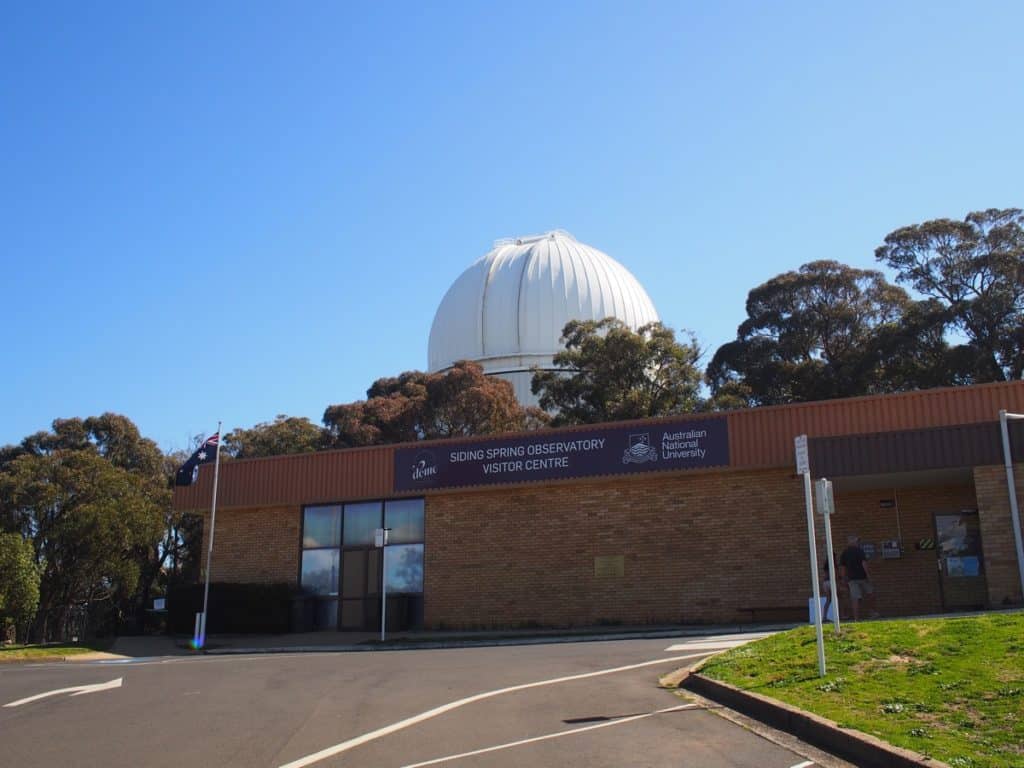
Siding Spring sits atop Mount Woorut, about 27km west of Coonabarabran, and is home to Australia’s largest optical telescope. Families can visit the AAT Visitor Gallery and Exploratory Centre most days of the week, take in the 3D theatre, and join a guided tour with a local operator for a proper look through the telescopes after dark. Once a year, the observatory throws open its doors for a free Open Day, with talks from working astronomers, kids’ activities, solar viewing and food stalls. It is a fantastic excuse to plan a Coonabarabran weekend around. Here’s our guide to visiting Coonabarabran.
Sydney Observatory, Millers Point
Sitting on Observatory Hill with harbour views thrown in for free, Sydney Observatory is the easiest option for families who don’t have the time to head to regional NSW. Daytime entry to the grounds and exhibitions is free, and the family-friendly night tour, suited to kids aged six and up, includes telescope viewing and a planetarium show.
Tickets and opening hours: Family tours run from from Wednesday to Sunday nights year-round,year-round, with extra sessions added during school holidays. Tickets for the night tour are sold online and typically need to be booked in advance, especially during the holidays, so get in early if you want a specific date. The grounds and daytime exhibitions are free and open daily without a booking.
Parkes Observatory (The Dish), Parkes
Made famous by the 2000 film about its role in broadcasting the Apollo 11 moon landing, Parkes Observatory is one of the largest single-dish radio telescopes in the Southern Hemisphere. Entry to the Visitor Discovery Centre is free, with hands-on exhibits, an accessible playground and picnic area, and a ticketed 3D theatre if the kids want more. It is an easy detour off the Newell Highway and works well as a stop on a bigger Central West road trip, perhaps paired with Dubbo or Coonabarabran.
Skywatch Observatory, Warrumbungle National Park
For families wanting to combine stargazing with a night’s stay right inside the Dark Sky Park, Skywatch Observatory offers accommodation alongside guided night sky tours, weather permitting. It is a smaller, more intimate setup than Siding Spring, with its own telescope on site, and suits families keen to properly commit to a stargazing weekend rather than a quick look on the way through.
Other Great Dark Sky Spots for Family Stargazing
Not every stargazing trip needs a telescope or a ticket. Some of the best family stargazing in NSW just needs a picnic rug and a clear night.
Palm Beach Headland, at Sydney’s northern tip, has been recognised as Australia’s first Urban Night Sky Place, and the walk out to Barrenjoey Lighthouse doubles as a great sunset-into-stars outing.
Cattai National Park, about an hour from the Sydney CBD in the Hawkesbury region, is a solid option if you want space to camp and stay for the night without the drive to the outback. Closer to town, Mount Kuring-gai on the edge of Ku-ring-gai Chase National Park has an open oval that is popular for casual picnic-blanket stargazing.
If you are chasing the darkest skies in the state and have the road trip appetite for it, Broken Hill in the Far West is about as dark as NSW gets, with low humidity and virtually no light pollution.
How to Spot the International Space Station

You don’t need a telescope, a dark sky reserve or even a particularly clear night away from town to spot the International Space Station. It’s visible with the naked eye from anywhere in NSW, including your own backyard, as long as the sky is clear and the timing is right.
The ISS orbits about 350km above Earth and is home to astronauts conducting ongoing scientific research. It’s usually visible for a few minutes around sunrise or sunset, when sunlight reflects off the station against a darker sky. To the naked eye it looks like a very bright, fast-moving star, gliding steadily across the sky without blinking or changing direction, unlike a plane.
NASA’s Spot the Station tool tells you exactly when and where to look based on your location, and the free NASA App can send you an alert whenever a good pass is coming up over your area. Both are worth bookmarking before a stargazing trip, since sightings only last a few minutes and it helps to know exactly where to look.
One easy mix-up: a line of several bright lights moving together across the sky isn’t the ISS, it’s a chain of Starlink satellites. SpaceX regularly launches these in groups, and they’re a genuinely fun thing for kids to spot in their own right. The Find Starlink website shows upcoming passes if you want to try and catch one.
Apps and Books to Help You Get Started
You don’t need any gear to start stargazing, just your eyes and, ideally, a good app to help you work out what you’re actually looking at.
A word of warning first: a lot of the big-name stargazing apps are built with the Northern Hemisphere in mind, and some will point you toward stars that simply aren’t visible from Australia. Worth checking hemisphere support before you settle on one.
Stellarium Mobile is free, ad-free and works well for both hemispheres, making it a solid all-round pick for families. Sky Map (Android) and SkyView Lite (iOS and Android) are simpler point-and-identify apps, both free, and easy enough for kids to use themselves. Star Walk 2 and Star Walk Kids have the most polished visuals and are popular with younger children, though it’s worth double-checking hemisphere accuracy before relying on them for constellation walks. If you want to track the ISS specifically, ISS Detector is a free, purpose-built option that pairs well with the tools mentioned above.
For families who prefer a book, 2026 Guide to the Night Sky: Southern Hemisphere is a month-by-month guide built specifically for the skies above Australia, New Zealand and South Africa, which makes it more genuinely useful here than most stargazing books on the shelf. Stargazing for Beginners (DK) is a good general introduction for parents or older kids wanting a bit more depth, and The Big Book of Stars and Planets (Usborne) suits preschool and early primary ages with simple explanations and bright illustrations.
Before buying anything, it’s worth checking your local library. Most NSW libraries carry a good range of astronomy titles for kids, and some also lend telescopes or offer digital copies through Libby.
How to Find Out About Meteor Showers, Eclipses and Aurora in Advance
The best sky events are all predictable well ahead of time, so with the right tools bookmarked, you’ll never miss a good one.
Meteor showers happen on the same dates every year, since they occur when Earth passes through the trail of debris left by a comet. The American Meteor Society runs a free meteor shower calendar that’s easy to bookmark, showing the peak night for each shower and roughly how many meteors you can expect to see. The Geminids in December and the Eta Aquariids in May are two of the more reliable showers for Australian viewers.
Eclipses are scheduled years in advance and easy to plan around. NASA’s eclipse website lists upcoming solar and lunar eclipses with exact local times once you enter your location. NSW families had a good one already this year: a total lunar eclipse, sometimes called a blood moon, was visible right across Australia on 3 March 2026, with totality lasting close to an hour and no equipment needed to watch it. There’s a partial lunar eclipse visible from NSW on 28 August 2026, though it’s a much subtler event than a total eclipse. The next big one to watch for is a total solar eclipse crossing the Australian mainland on 22 July 2028, passing directly over Sydney, which will be the first total solar eclipse visible from Sydney since 1857.
Aurora australis (the Southern Lights) is the trickiest to plan for, since sightings depend on unpredictable solar activity and are rare this far north. The Bureau of Meteorology’s Space Weather Services is the tool to bookmark, since it’s built specifically for Australian conditions and issues aurora alerts when a display is likely to be visible. The free My Aurora Forecast & Alerts app is a good option too if you’d rather get a push notification than check a website. Either way, a good display can appear with only a few hours’ notice, so this is really about being ready to head outside quickly rather than planning ahead the way you would for an eclipse.
Space Events and Space Camps for Kids in NSW
Siding Spring Observatory Open Day (Coonabarabran) Held once a year, usually in the second half of the year, this free event opens the observatory’s telescopes and facilities to the public. Expect talks from astronomers, kids’ presentations, solar viewing, market stalls and tours of the AAT, the 2.3m telescope and the Huntsman Telescope. No bookings needed, but check the exact date each year as it shifts slightly.
Sydney Observatory school holiday programs Sydney Observatory runs free, drop-in activities during most school holiday periods, including hands-on space science sessions for younger kids and storytelling in the grounds. Sydney Observatory Late, a free evening of stargazing and talks, also runs monthly for families who want a taste of the night tour experience without the ticket price.
Aerospace Camp and Aerospace Academy, regional NSW Run by the One Giant Leap Australia Foundation with NSW Government backing, Aerospace Camp is a four-day, curriculum-linked residential STEM program for students aged around 11 to 15, covering rocket building, flight simulators, drones and space careers. Some regional camps are fully funded for local students, while others, such as the Goulburn camp, run on a paid basis. Aerospace Academy is a shorter, free school holiday day program aimed at the same age group, also focused on space and aviation careers.
National Science Week (August) Held nationally each August, National Science Week brings a wave of space and astronomy-themed events to schools, museums and community groups across NSW, including at some of the observatories above. Worth checking each year if you are after a term three excuse to get the kids into a telescope session.
Good to Know
- Best viewing conditions are on clear, moonless nights, away from streetlights
- Download a free stargazing app before you go so kids can identify planets and constellations in real time
- Rug up. Even summer nights can turn cold once you are away from town, especially anywhere with altitude like Siding Spring or the Warrumbungles
- Most observatory night tours have a minimum age, usually five or six, so check before booking if you have younger children
- Book night tours well ahead during school holidays and long weekends, particularly at Sydney Observatory and Siding Spring
- Want to spot the ISS instead? Check NASA’s Spot the Station tool for pass times over your location, no booking or dark sky needed
FAQ
Warrumbungle National Park, near Coonabarabran, is the standout choice thanks to its Dark Sky Park status and Siding Spring Observatory. For families who cannot travel that far, Sydney Observatory and Palm Beach Headland are the easiest options closer to the city.
Daytime visits to Sydney Observatory and Parkes Observatory do not require bookings, but night tours at both Sydney Observatory and Siding Spring should be booked in advance, especially during school holidays.
Many of the best options are free or low cost. Daytime entry to Sydney Observatory and Parkes Observatory is free, as is the annual Siding Spring Open Day and most dark sky spots like Palm Beach Headland and Mount Kuring-gai. Night tours and 3D theatre sessions usually carry a ticket price.
Most kids from about five or six get real value from a guided observatory tour, once they can handle staying up later and following a talk. Younger children will still enjoy an unguided stargazing picnic or the daytime exhibits at any of the observatories above.
Yes. The ISS is visible to the naked eye from anywhere in NSW on clear nights, usually around sunrise or sunset. NASA’s Spot the Station tool gives exact pass times for your location, no equipment or dark sky spot required.