
ANZAC Day on 25 April is one of Australia’s most significant days of remembrance — and it’s never too early to start sharing its meaning with your kids. Whether your children are toddlers or teenagers, there are ways to mark the day that go beyond simply watching the news.
Attending a dawn service or march is the most meaningful way to observe the day, but there are plenty of other ways to help kids understand and appreciate the sacrifice of the ANZACs. Here are some ideas for families in Newcastle, Lake Macquarie, the Hunter Valley and beyond.
Looking for local dawn services and marches? See our guide to ANZAC Day events across Newcastle, Lake Macquarie and the Hunter.
Table of contents
- Attend a Dawn Service or March
- Watch the Dawn Service at Home
- Read an ANZAC Day Book
- Listen to an ANZAC Day Storytime
- Visit a Local War Memorial
- Walk the Newcastle Memorial Walk
- Look for the Giant Poppies in Maitland
- Explore Stories and Videos Online
- Watch an Interactive Documentary
- Download a Free Ebook
- Bake ANZAC Biscuits
- Make ANZAC Day Crafts
- Research a Relative
- Visit Gallipoli via Google Street View
- Place a Poppy in Your Window
Attend a Dawn Service or March
The dawn service is the heart of ANZAC Day. Across the Newcastle and Hunter region, services are held at locations including Nobbys Beach, local RSL clubs and suburban parks — and attending one, even briefly, makes the day feel real for kids in a way that nothing else quite does.
Dawn services typically start between 5.30am and 6am, so it’s worth planning ahead. Younger kids often manage better than you’d expect if they’re wrapped up warm and know what to expect. See our full guide to ANZAC Day services and marches in Newcastle, Lake Macquarie and the Hunter for times and locations.
Watch the Dawn Service at Home
If getting out before dawn isn’t possible with your family, you can still mark the moment at home. The national Dawn Service from the Australian War Memorial in Canberra is broadcast live on ABC TV and streamed online each year. The Newcastle Dawn Service at Nobbys Beach is also broadcast on NBN and streamed online.
Rising before dawn, watching together in the quiet of the morning, and talking about what you’re seeing can be just as meaningful — particularly for younger kids who might find a crowded outdoor service overwhelming.
Read an ANZAC Day Book

Picture books and chapter books are one of the best ways to explain ANZAC Day to kids in an age-appropriate way. There are some genuinely beautiful titles available — from simple stories for preschoolers to more detailed accounts for older primary school children.
Some favourites include Anzac Ted, Meet the Anzacs and A Soldier, a Dog and a Boy. For a local connection, look out for Turkish Charlie Ryan: Canakkale’s Anzac Hero — a book with ties to Thornton Public School, written by John Gillam and Yvonne Fletcher and illustrated by local illustrator Lillian Webb. The story of Charlie Ryan, an Australian medic from country Victoria, was discovered through a connection between Thornton Public School students and students at Turkish school TED Mersin College — a remarkable story in itself.
See our full ANZAC Day books for kids guide for recommendations across every age group.
Listen to an ANZAC Day Storytime
If you’d prefer to listen rather than read, Storybox Australia is worth knowing about. It features hundreds of Australian picture books read aloud by storytellers, and it’s free if you’re a member of a local library. The ANZAC Day collection includes Anzac Ted, Anzac Biscuits and Alfred’s War.
To access it, log into Storybox Australia, select your library and enter your library card number. Check with your local library to confirm access is currently available.
Visit a Local War Memorial
If you can’t make it to a service, visiting a local war memorial is a simple and quiet way to pay your respects. Many kids find them surprisingly moving once they understand what they’re looking at.
The Places of Pride database from the Australian War Memorial records the location of every publicly accessible memorial in Australia, with an interactive map to help you find one near you. There are more than 25 memorials in the Newcastle region alone.
Walk the Newcastle Memorial Walk

The Newcastle Memorial Walk at Strzelecki Lookout is one of the most powerful and underrated spots in the city. Built to commemorate the ANZAC centenary, the 450-metre clifftop walkway features steel silhouettes of ANZAC soldiers engraved with family names — representing almost 11,000 known Newcastle and Hunter Valley men and women who enlisted during World War I.
History panels along the walk explain different aspects of the conflict, and the views over the coast are spectacular. It’s a genuinely moving place to bring kids, and the walk itself is easy enough for most ages. Combine it with a visit to nearby Nobbys Beach to make a morning of it.
Look for the Giant Poppies in Maitland
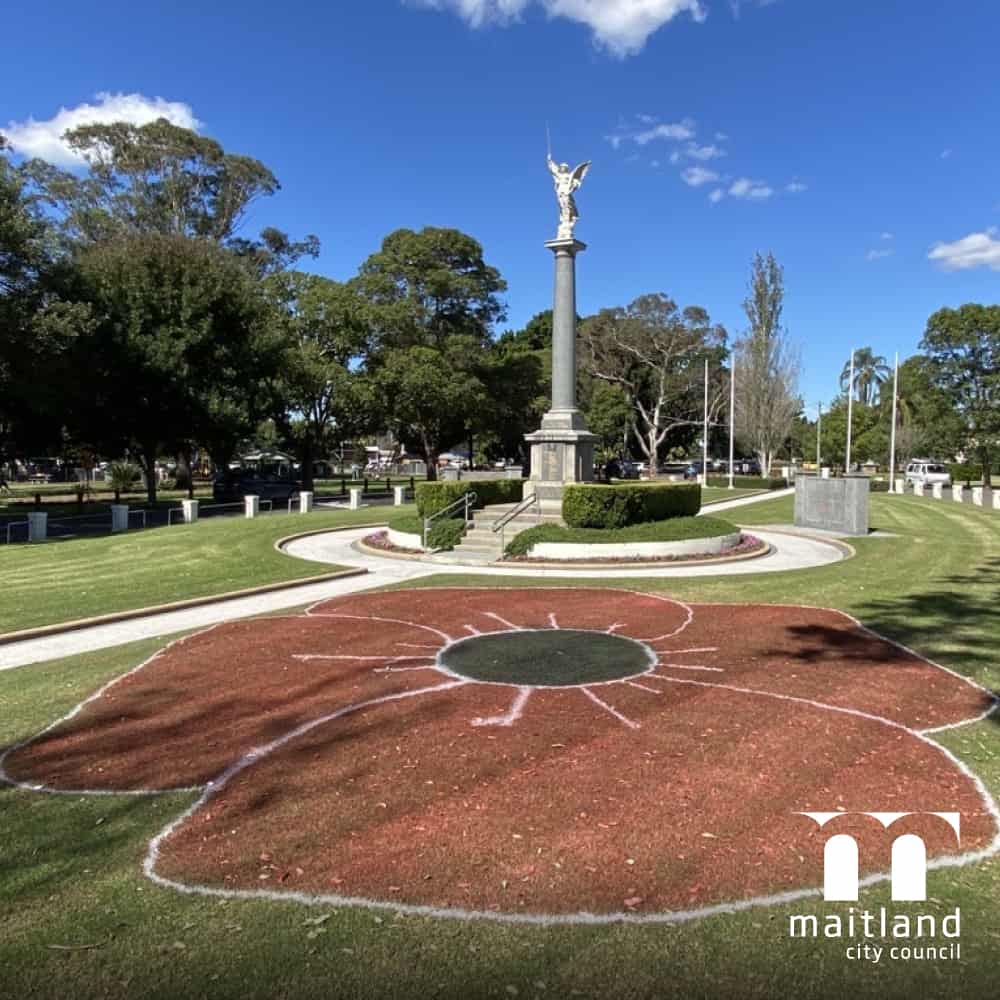
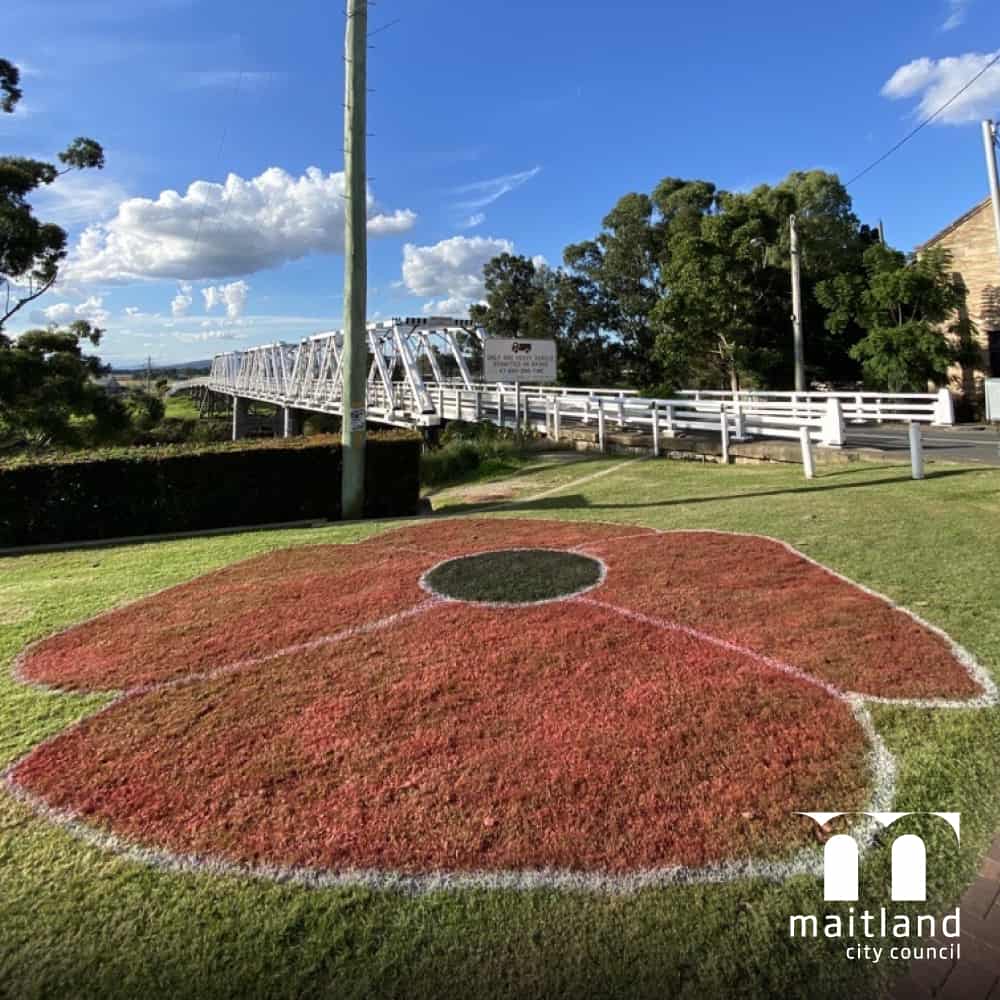
Each year, Maitland City Council installs giant poppies around the city to commemorate ANZAC Day. Locations vary from year to year — check with Maitland City Council closer to the date for where to find them. It’s a simple and visual way to mark the occasion with younger kids who respond well to seeing the symbols of remembrance out in their community.
Explore Stories and Videos Online
The Australian War Memorial website has a solid collection of resources for families. A Very Special Day is aimed at primary school-age kids and includes a short video, The Red Poppy. For kids aged 8–12, ABC Kids’ BTN (Behind the News) has a range of ANZAC Day videos including The Gallipoli Story, Indigenous ANZACs and The Animals of WW1 — all presented in a format kids can actually follow.
Watch an Interactive Documentary
Days in Conflict is an interactive documentary series in six parts, suitable for upper primary and secondary students. Free to access on computers and tablets, it covers the Gallipoli campaign through to the Western Front, the Middle East, women’s roles, Indigenous soldiers and life on the Home Front. A good option for older kids who want more depth than a short video clip.
Download a Free Ebook
The Australian War Memorial offers a number of free ebooks available for educational use. Options include Audacity (stories of extraordinary courage in wartime) and Devotion (the story of Australian nurses over more than 100 years of service). For younger readers, M is for Mates is an award-winning picture book covering animals A–Z in war — a gentle entry point for primary-aged kids.
Bake ANZAC Biscuits

Baking ANZAC biscuits is a tradition that works for kids of almost any age — and it’s a good conversation starter about why the biscuits exist. The story goes that during World War I, wives and mothers baked them to send to troops at the front, as the ingredients kept well without refrigeration.
There are plenty of recipes available depending on whether you’re in the crunchy or chewy camp. Here’s a link to the original 1914 version from the CWA Cookbook as well as an ANZAC biscuit recipe by Donna Hay which combines crunchy and chewy aspects.
Make ANZAC Day Crafts
Making red poppies from crepe paper is a classic activity that even young kids can do with a little help. The For Teachers For Students website has clear instructions. If you’re looking for something a bit different, an ANZAC Day lantern is another option — there are simple tutorials online using materials you’ll likely already have at home.
Research a Relative
For older kids especially, researching a family member who served can make ANZAC Day feel personal rather than historical. The Australian War Memorial’s Roll of Honour records details of Australian armed forces members who died during wartime and peacekeeping operations — including photos, rank, unit and next-of-kin correspondence where available.
A Newy with Kids reader Kate researched her relative Stanley Millwood Garnham originally from Morpeth who was killed in action in Gallipoli. As well as a photo, the entry contains information about his rank, unit and a copy of his circular. It’s a poignant activity for kids to learn about the sacrifices of their family member. Even if your family has no direct connection, searching a name from your local area — like Stanley Millwood Garnham — gives kids a real person to think about rather than an abstract concept.
Visit Gallipoli
Through Google Street View, you can the cemeteries and memorials of Gallipoli. You can walk through the Lone Pine Cemetery and Memorial which stands on the site of the fiercest fighting at Lone Pine. It commemorates more than 4,900 Australian and New Zealand servicemen who died in the ANZAC area. You can also experience the ANZAC Ceremonial Area which is where ANZAC Services are held each year.
You can also read the poignant words engraved at ANZAC Cove attributed to Kemal Ataturk, Commander of the Turkish 19th Division during the Gallipoli Campaign and the first President of the Turkish Republic.

“Those heroes that shed their blood and lost their lives. You are now living in the soil of a friendly country therefore rest in peace. There is no difference between the Johnnies and the Mehmets to us where they lie side by side here in this country of ours. You, the mothers, who sent their sons from faraway countries wipe away your tears; your sons are now lying in our bosom and are in peace. After having lost their lives on this land they have become our sons as well.”
Place a Poppy in Your Window
A simple gesture: make a red poppy from crepe paper or print one out and stick it in your window for passers-by to see. It’s a small act of community remembrance that even very young kids can participate in — and it can prompt good conversations about why the poppy matters.