
Recording your family history is one of those projects that always feels like it can wait until next month. It can’t. Parents and grandparents carry stories that exist nowhere else, and once they’re gone, those stories go with them.
The good news is you don’t need special equipment, training or a huge block of free time. A phone, a notepad and a bit of intention are enough to get started. Below are practical ways to capture family memories, along with tips on how to actually get older relatives talking.
If you don’t recount your family history, it will be lost. Honor your own stories and tell them too. The tales may not seem very important, but they are what binds families and makes each of us who we are – Madeleine L’Engle
Take Photos and Videos of Everyday Family Moments
The easiest way to capture family memories is to simply have your phone out more often. Get in the habit of filming short clips at birthdays, weddings and everyday visits, not just posed photos but grandparents chatting, kids playing with cousins, everyday kitchen moments. These candid clips end up mattering more than formal portraits.
If you want something more polished, a professional multi-generational photo session is worth the cost for a milestone occasion. But the phone footage from an ordinary Sunday lunch is often what gets watched again and again years later.
Interview Older Relatives About Their Life Story
Sitting down with a parent or grandparent, in person or over a video call, and recording a proper conversation is one of the most valuable things you can do. Use your phone’s voice memo app or a simple video call recording, and come prepared with a few open-ended questions, such as:
- What is your happiest childhood memory?
- What were your favourite subjects at school?
- Tell me about your parents and your brothers or sisters.
- Are there any family traditions or family legends?
- What was your first job?
- Tell me about your wedding day.
If a relative feels self-conscious being interviewed on camera, hand them a small voice recorder instead so they can talk privately and at their own pace.
Record Your Family’s Migration or Cultural Story
For a lot of Australian families, the family history isn’t only personal, it’s tied to why the family ended up in Australia in the first place. If a parent or grandparent migrated here, or grew up in a different cultural tradition, ask specifically about that journey: why they left, what the trip was like, what they missed most, and what they chose to keep or change once they arrived. These stories often carry more weight for kids than a general “tell me about your childhood” prompt, and they’re the ones most at risk of being lost if nobody thinks to ask.
Ask Family Members to Write Down Their Memories
Not every story needs to be spoken. Give parents and grandparents a blank notebook and ask them to write about their childhood, school years, working life, and memories of their own parents. Handwritten memories become a keepsake in themselves, separate from video or audio.
You can also use Storyworth which provides a year’s worth of story prompts for one storyteller. Recipients then reply with an email to each question prompt. At the end of the year, you’ll receive a hardcover book with a black & white interior (and a full color cover) containing all your memories.
Collect and Digitise Old Family Photos and Documents
Search through the trove of family photos and pull out some treasured ones. Do a call out throughout the relatives for old photos. Often different family members have photos that you may not be familiar with. Scan them in and save digital copies of the old prints.
Record the names of the people in the photo, location and approximate year. This is where older members of the family might be able to provide further details and the stories behind the photo.
Store digital copies in more than one place, such as cloud storage and an external drive, so nothing is lost to a broken device. Family documents like birth certificates, marriage records and letters are worth digitising too, since paper originals fade and deteriorate over time.
Research Your Family History Through Trove and NSW State Archives
Once you’ve gathered what your family already has, two free resources can fill in the rest. Trove, run by the National Library of Australia, has digitised newspapers, birth and death notices, and historical records stretching back well over a century, all searchable from home. NSW State Archives holds land, court and immigration records specific to New South Wales, useful if your family has roots in Newcastle, the Hunter or elsewhere in the state. Neither costs anything to search, and a single old newspaper notice can confirm a date or fill in a detail that a relative’s memory alone can’t.
Build a Family Tree
A family tree helps kids understand where they fit into a bigger family story. Free tools such as MyHeritage let you build a tree online, invite relatives to add their own branches, and upload photos as you go, including from a mobile app during a family gathering.
Some families can trace three or four generations back. Others, using genealogical records like those on Trove, can go back ten or more. Either way, the process itself tends to spark stories you wouldn’t have heard otherwise.
Record Family Recipes
If you have special family recipes, honour them and record them in a book that can be shared with the family. If you don’t have recipes, ask your extended family for them and write down family recipes.
After the passing of her grandmother, a friend took her Nana’s handwritten Ukrainian perogy recipe and framed it as a special keepsake which she houses in her kitchen. Every year, family members get together at her house for a day of perogy-making following Nana’s recipe.
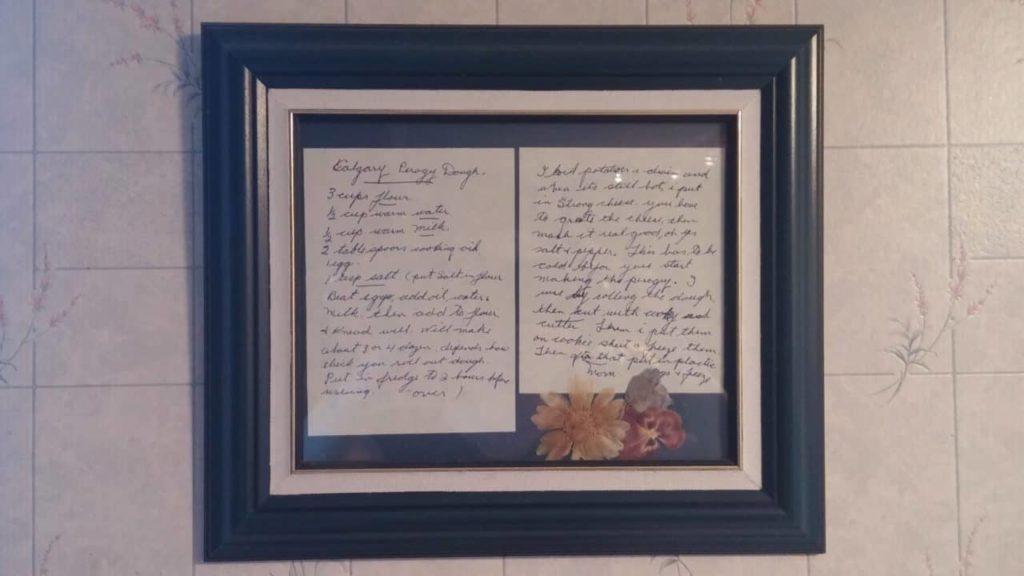
If you can’t get family members to write down recipes, film them the next time they make the recipe so you can see what they do.
Create a Family Memory Box
A memory box is a physical companion to all the digital recording above. Fill a box with letters, small keepsakes, ticket stubs and a written note, then seal it to be opened at a future milestone such as an 18th birthday, a wedding or the birth of a first child. It’s a simple project that pairs well with a family reunion or milestone birthday, and gives kids something tangible to look forward to opening years later.
Write Letters or Record Messages for the Future
Ask a parent or grandparent to write a letter, or record a short video message, addressed to a grandchild’s future self, to be opened at a set milestone like a 21st birthday or wedding day. It’s a small ask that often produces some of the most treasured recordings a family ends up with, and it pairs naturally with a memory box if you’re building one.
Visit Places of Significance for your Family
Take the kids to see a childhood home, a school, or a wedding venue that means something to your family’s story. If travel isn’t practical, Google Earth or a simple online image search can bring a faraway location up on screen in seconds, which is often enough to prompt a flood of memories from an older relative.
Use a Family Reunion to Record Everything at Once
If a family reunion or big Christmas gathering is coming up, it’s the single best opportunity to tackle several of these ideas in one day. Set aside twenty minutes for a group interview, get a proper multi-generational photo while everyone is together, ask someone to demonstrate a family recipe, and pass around old photos for people to identify. One well-planned afternoon can produce more material than months of separate visits.
Turn It All Into a Video Montage or Family History Book
Once you’ve gathered interviews, photos and recipes, the last step is pulling it into something the whole family will actually sit down and watch or read. A simple video montage set to music, made in an app like iMovie, turns scattered clips into something people will revisit every Christmas. A printed photo book works the same way for the written and photo side of things. This is the step most families skip, so it’s worth putting a date in the calendar to finish it rather than letting the raw footage and scans sit in a folder unfinished.
FAQs About Recording Family History
Start with what’s easiest to access: a recorded conversation with an older relative, a box of old photos, or a handwritten recipe. Combining spoken interviews, written memories and photos gives the most complete picture, but any one of these is a good starting point.
Filming short, casual video clips on your phone at everyday family gatherings is the lowest-effort option with the highest payoff. It doesn’t require scheduling a formal interview, just a habit of pulling your phone out a little more often.
Open-ended questions work best: favourite childhood memories, first jobs, wedding day stories, and family traditions. Avoid yes-or-no questions, since they tend to shut a conversation down rather than open it up.
It depends on the family and available records. Some people can only trace back three or four generations, while others use genealogical archives to trace back ten or more.
Yes. Trove and NSW State Archives are both free to search and hold digitised newspapers, records and archival material that can fill in details a family’s own memory or photos might be missing.
You might also like:
How to Keep In Touch With Grandparents & Elderly Relatives
50 Fun Activities For Grandkids & Grandparents in Newcastle, Lake Macquarie & Hunter